How much protein do you actually need?

Everyone is different, your personal target depends on your bodyweight, how active you are, your age, and how you spread it across the day.

7 min read · Based on peer-reviewed sports-nutrition research

The short answer

The standard guideline, 0.8g of protein per kg of bodyweight, is the minimum to avoid deficiency, not the amount that's optimal. Most active people do better on 1.2–2.0g per kg, and older adults on at least 1.0–1.2g, ideally spread across the day in 20–30g portions of complete protein rather than one big hit.

"How much protein do I need?" sounds like it should have one number as an answer. It doesn't, and the single number most people have heard is misleading. Here's how to find the figure that's actually right for you, and the two things that matter almost as much as the daily total.

The number everyone quotes is a floor, not a target

The famous figure, 0.8g of protein per kilogram of bodyweight, is the Recommended Dietary Allowance. It's worth knowing exactly what that means: it's the amount calculated to stop a sedentary adult becoming deficient. It's a floor designed to prevent a problem, not a target designed to optimise muscle, recovery or healthy ageing. Treating the minimum as the goal is the most common mistake in this whole topic.

Same word, very different jobs

"Enough" vs "optimal"

RDA (the floor)
0.8 g/kg
General active
1.2–1.6 g/kg
Building muscle
1.6–2.2 g/kg
For most people with a goal beyond 'not deficient,' the useful range is roughly double the RDA.

So what do you actually need?

Because the answer scales with bodyweight, it's easiest to see it for your own. Set your weight and compare the ranges for different goals.

Find your range

Protein per day, by goal

70 kg
Sedentary minimum
0.8 g/kg · RDA floor
56g/day
General active
1.2–1.6 g/kg
84–112g/day
Building muscle
1.6–2.2 g/kg
112–154g/day
Older adult (protect muscle)
1.0–1.2 g/kg
70–84g/day
Ranges from ISSN (exercise) and PROT-AGE / ESPEN (older adults). Individual needs vary, use as a guide.

It's not just the daily total, it's per meal

Your muscles rebuild in response to a meal, not just a daily sum. Each feeding triggers a window of muscle protein synthesis that lasts a few hours, and that response is switched on once a meal crosses a threshold, roughly 20–30g of quality protein (a little more for older adults). Beyond about 40g in one sitting, the muscle-building benefit largely plateaus.

Spread beats stacking

Where most people fall short: breakfast

Breakfast
~10g
below threshold
Lunch
~25g
crosses threshold
Dinner
~40g
crosses threshold
Snack
~5g
below threshold

A typical day crosses the muscle-building threshold twice. Lifting breakfast from ~10g to ~30g adds a third window, often the single easiest improvement to make.

Spreading protein across 3–4 meals of ~25–30g works better than one large evening dose.

Not all protein counts equally

A gram of protein on a label isn't always a gram of usable protein. "Complete" proteins contain all nine essential amino acids in the right proportions; many single plant sources are low in one or more, and some proteins are incomplete by nature. Scientists rank usable quality with a measure called DIAAS.

Protein quality (DIAAS)

Not every gram is equal

Whole egg
1.13
Milk
1.18
Whey
1.09
Chicken
0.95
Pea protein
0.82
Wheat
0.4

A score of 1.0+ means excellent, complete protein. Higher quality means you need fewer grams to hit the same effect, and egg sits right at the top.

DIAAS measures how much of a protein your body can actually absorb and use.

Two practical takeaways: most people aiming for muscle, recovery or healthy ageing want to land well above the RDA, and they want it as complete protein spread across the day , not stacked into one meal.

How real food fits in

A shake earns its place not as a replacement for food, but as the easiest way to put a complete, threshold-crossing portion of protein where days usually fall short, breakfast. WholeFuel's protein comes from egg whites, whole egg and bone broth, real-food, complete, high-quality protein (plus around 7g of collagen).

The easiest way to work it in is a breakfast smoothie. One scoop crosses the 20–30g muscle-building threshold on its own, then the fruit, fats and fibre you add turn it into a proper meal, not just a protein hit.
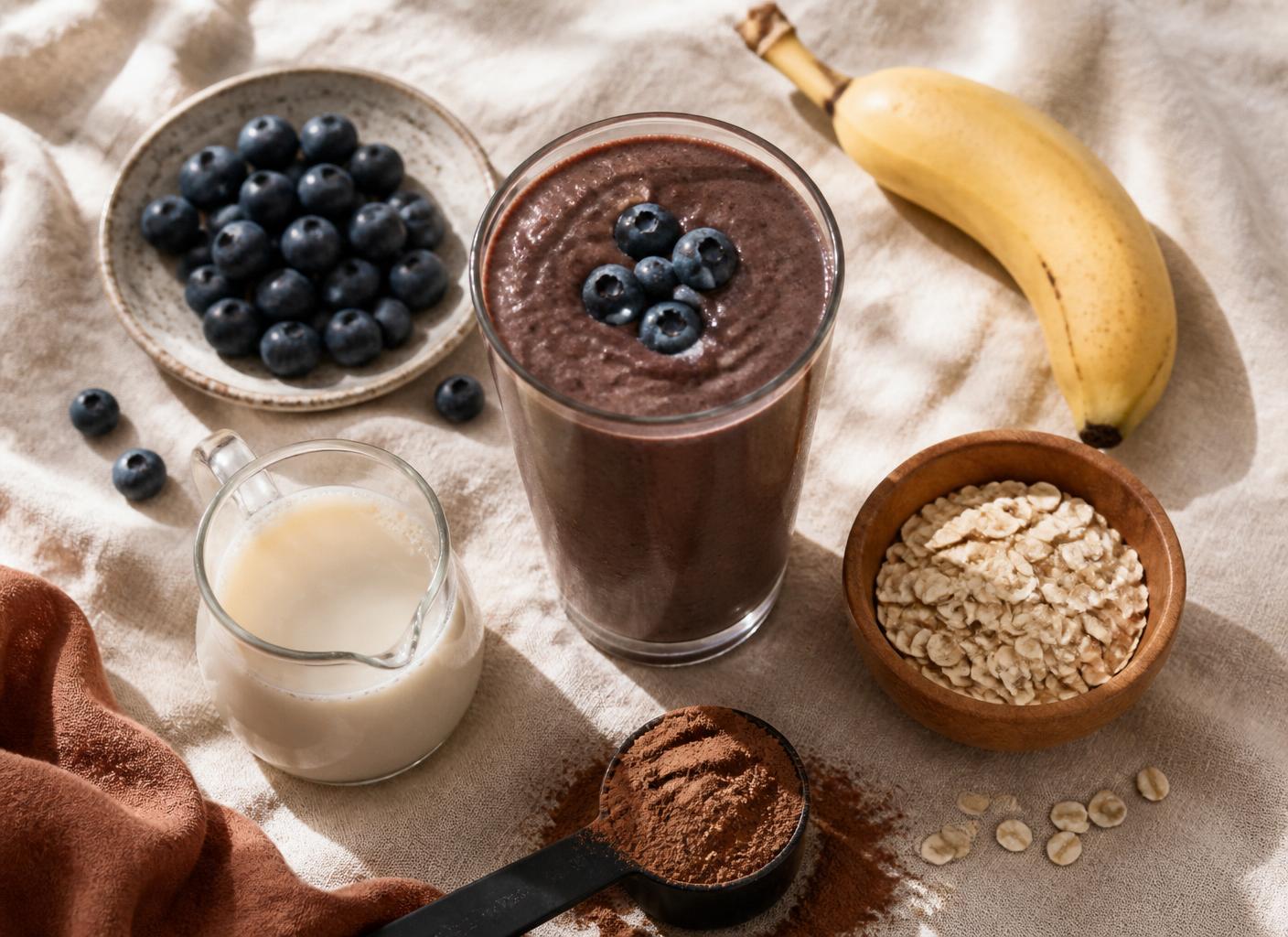
Overhead flat lay of a chocolate-blueberry WholeFuel breakfast smoothie surrounded by fresh blueberries, banana, oats, almond milk and a scoop of cocoa protein powder
Recipe · 5 minutes~31g protein

The threshold-crossing breakfast smoothie.

One scoop clears the muscle-building threshold on its own. The fruit, fats and oats turn it into a proper meal, not just a protein hit.

Ingredients

  • 1 scoopWholeFuel Cocoa Hazelnut
  • 500 mlunsweetened almond milk
  • 1small frozen banana
  • 60 gfrozen blueberries
  • 60 grolled oats

Method

  1. 1500ml almond milk into the blender first, so the blades catch.
  2. 2Add the banana, blueberries, oats and one scoop of WholeFuel.
  3. 3Blend on high for 45–60 seconds until fully smooth.
  4. 4Pour and drink within the first hour of waking.

Per serving

~31gprotein~7gcollagen~16gfat~84gcarbs~12gfibre
Swap freely: berries for the banana, Greek yoghurt for the milk, chia for the oats.

Swap freely: berries for the banana, Greek yoghurt for the milk, chia or flax for the oats. The point is the base, one scoop of complete, real-food protein turns whatever you throw in the blender into a breakfast that actually crosses the threshold.

Frequently asked questions

Is 0.8g of protein per kg enough?+

0.8g/kg is the RDA, the minimum to prevent deficiency in a sedentary adult, not the optimum for health, muscle or healthy ageing. Active people and older adults generally do better well above it: roughly 1.2 to 2.0g/kg depending on goals.

How much protein do I need to build muscle?+

For building or maintaining muscle, sports-nutrition guidance puts most people at 1.6 to 2.2g of protein per kg of bodyweight per day, alongside resistance training. A 70kg person would aim for roughly 112 to 154g a day.

Can your body only absorb 30g of protein at once?+

This is a myth. Your gut absorbs essentially all the protein you eat. What plateaus is the muscle-building response per meal, it maxes out around 20 to 40g of high-quality protein. Extra protein isn't wasted; it's used for other functions. For muscle, spreading protein across meals works better than one large dose.

Do older adults need more protein?+

Yes. With age the muscle-building response to protein blunts, called anabolic resistance, so older adults need more protein per meal to get the same effect. Expert groups recommend at least 1.0 to 1.2g/kg per day, and more during illness.

Does the quality of the protein matter?+

Yes. Complete proteins contain all nine essential amino acids in usable amounts. On the DIAAS quality scale, whole egg, milk and meat score highest; most single plant proteins score lower and collagen is incomplete.

Close the gap with real food

Over 20g of complete, high-quality protein per serving, from 9 real ingredients, nothing isolated or artificial.

Get started now - 30-day money back guarantee
verified reviews·Judge.me

Sources

  • Jäger et al., 2017, International Society of Sports Nutrition Position Stand: Protein and Exercise (1.4–2.0g/kg; up to 2.3–3.1g/kg when cutting)
  • Bauer et al. (PROT-AGE) & ESPEN Expert Group, protein for older adults (1.0–1.2g/kg, more with illness)
  • Research on the leucine threshold and per-meal muscle protein synthesis (~20–40g; even distribution)
  • Research on protein, satiety and weight management
  • DIAAS protein-quality data (egg, milk, whey, chicken, plant proteins)

This article is educational and not medical or dietary advice. Figures are general guidance; individual needs vary with health status, training and goals.